

Multi-Instance vs Multi-Tenant Architecture: SaaS Comparison Guide

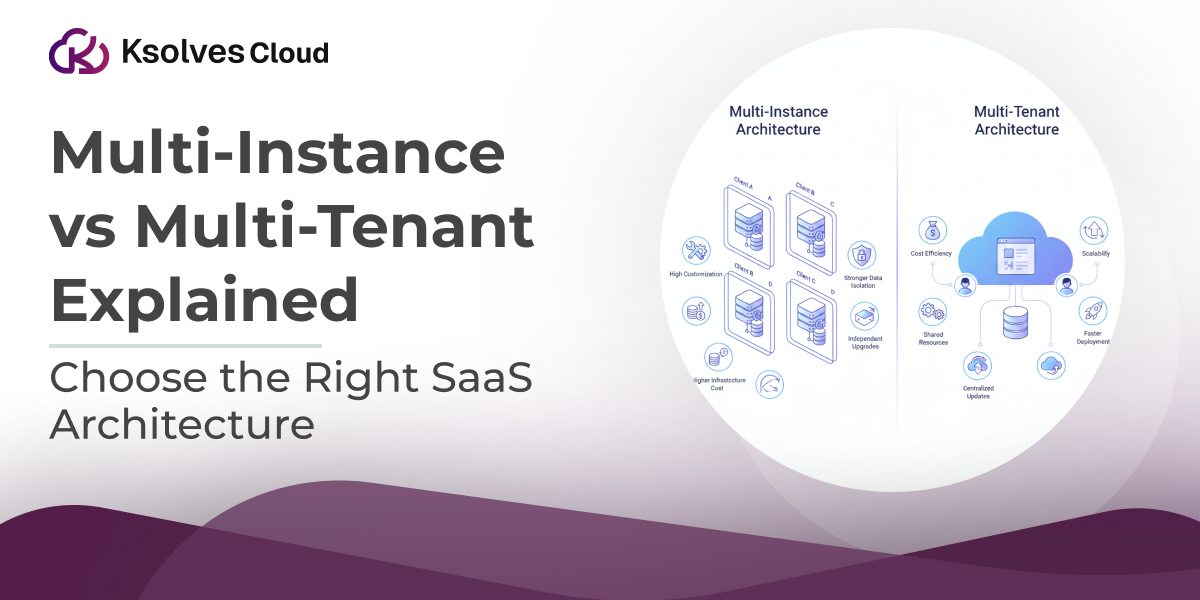
Choosing the right SaaS architecture is a strategic decision that directly influences scalability, security, performance, and long-term operational costs. As SaaS platforms grow and serve different types of customers, the internal structure of applications and data plays a crucial role in overall performance and reliability. Two common architecture models include multi-tenant and multi-instance, which guide how SaaS applications are developed, deployed, and scaled to support this growth effectively.
While both models enable software delivery at scale, multi-instance vs. multi-tenant architectures differ significantly in resource sharing, data isolation, customization, and maintenance. Understanding these differences helps businesses design SaaS platforms that align with their growth objectives, customer expectations, and compliance requirements.
What is SaaS
Software as a Service (SaaS) refers to cloud-based applications that are hosted and managed by a third-party provider and accessed over the internet. Instead of buying software licenses and maintaining infrastructure, businesses subscribe to SaaS solutions on a pay-as-you-use model. Popular examples include CRM platforms, ERP systems, eCommerce solutions, and payment gateways. The service provider handles everything, including data storage, security, updates, and performance, allowing organizations to focus on using the software rather than managing it. This model reduces upfront costs, improves scalability, and enables faster adoption of new technologies without complex deployments.
SaaS Architecture
SaaS solutions are generally designed using two primary architectural models: multi-instance and multi-tenant. In this context, a tenant represents an individual customer, team, or organization using the application. While other models exist—such as single-instance deployments, shared-database multi-instance setups, or flexible tenancy – they are less commonly adopted in mainstream SaaS platforms.
What Is Multi-Instance Architecture?
In a multi-instance SaaS model, each customer has a dedicated instance of the application and its own database. Resources are isolated per customer, with no sharing at the application or data storage layer.
Key Benefits
Strong Data Isolation and Security
Each customer’s application instance runs independently with its own database. This segregation minimizes the risk of data exposure or cross-tenant leakage, which is crucial for organizations with stringent compliance and regulatory requirements.
Customer-Level Scalability
Resource scaling, CPU, memory, and storage can be performed on a per-customer basis without affecting any other tenant. This isolation simplifies performance tuning for individual needs.
Increased Availability
A failure in one instance does not cascade to others. Outages are localized, preserving uptime for unaffected customers.
High Customization Ability
Dedicated instances allow tailored configurations, feature sets, update schedules, and integrations, which can be a competitive advantage in bespoke enterprise deployments.
Challenges
Operational Complexity
Since each customer operates on a dedicated infrastructure, every environment must be individually provisioned, monitored, maintained, and upgraded. This increases operational effort, as updates and maintenance tasks need to be performed separately for each customer instance.
Higher Costs
Dedicated resources for every tenant mean costs do not benefit from economies of scale. The total cost of ownership for the provider is generally higher when compared to shared architectures.
What is Multi-Tenant Architecture?
In a multi-tenant model, a single application instance serves all customers, typically backed by a shared database. Data separation relies on application logic rather than physical segregation.
Key Benefits
Lower Cost and Higher Efficiency
Shared infrastructure significantly reduces operational costs for the SaaS provider. Resource utilization is optimized across customers rather than consumed per instance.
Simplified infrastructure management
With a single shared environment, maintenance and monitoring become easier compared to managing multiple isolated setups.
Faster setup and development
This architecture is quicker to deploy than a multi-instance model, allowing teams to build, release, and scale the SaaS application with less effort and fewer resources.
Consistent and up-to-date platform
Updates and enhancements are applied once and automatically rolled out to all users, ensuring everyone benefits from the latest features and fixes at the same time.
Challenges
Data and Security Risks
Although tenants’ data is logically separated, a shared database increases blast radius: any vulnerability or misconfiguration can potentially affect all customers. Proper data access controls and application-level security are essential.
Limited Customization
Providing tenant-specific features or configurations becomes harder because all customers share the same application footprint. While feature flags and permissioning can help, deep customizations may be constrained.
Performance Contention
Shared resources raise the possibility of “noisy neighbors,” where a single customer’s workload impacts performance for others. Architectural mitigations and resource throttling strategies are often required.
Key Differences: Multi-Tenant vs Multi-Instance SaaS
| Aspect | Multi-Tenant Architecture | Multi-Instance Architecture |
| Application Setup | Single shared application instance for all customers | Separate application instance per customer |
| Data Storage | Shared database with logical data isolation | Dedicated database per customer |
| Cost Efficiency | Lower infrastructure and operational costs | Higher cost due to isolated resources |
| Scalability | Scales at platform level | Scales independently per customer |
| Security & Isolation | Logical isolation; higher blast radius if misconfigured | Strong physical isolation and security |
| Customization | Limited, usually via feature flags | High, customer-specific customization |
| Maintenance & Updates | Easier—single deployment and upgrade | More complex—updates per instance |
| Performance Impact | Risk of noisy-neighbor issues | No cross-customer performance impact |
| Time to Market | Faster to launch and iterate | Slower due to setup complexity |
| Best Suited For | Startups, SMBs, cost-focused SaaS products | Enterprises, regulated industries, premium SaaS |
Which Model Should You Choose?
There’s no universally superior architecture; the choice depends on business priorities:
- Time to Market and Cost Efficiency: A multi-tenant approach typically accelerates delivery and lowers operational costs.
- Security, Compliance, and Customization: Multi-instance architectures better support strict isolation and bespoke configurations, favored by larger enterprises or regulated industries.
Often, providers begin with multi-tenant models to capture market share and may introduce multi-instance or hybrid patterns as enterprise demand grows. Hybrid approaches allow selective database isolation or tenant clustering strategies to balance risk, performance, and cost.
Overcome Odoo SaaS Limitations with Ksolves SaaS
If you are looking for a reliable and efficient SaaS platform for Odoo hosting, Ksolves Odoo SaaS is the right choice. While many SaaS platforms in the market struggle with scalability, DevOps complexity, limited customization, and operational challenges, Ksolves Odoo SaaS is purpose-built to overcome these limitations. It offers seamless scaling, flexible customization, and simplified management tailored for growing businesses. Contact us today to explore how Ksolves Odoo SaaS can support your needs and request a free trial.


 1800 121 0218
  +1 (646) 203-1075
  +91 8527471031
 sales@ksolves.com
One thought on “Multi-Instance vs Multi-Tenant Architecture: SaaS Comparison Guide”